
Beyond The Debate
Beyond the Debate: A Deeper Dive into “Skills vs. Certificates” in Kenya’s Workforce Transformation
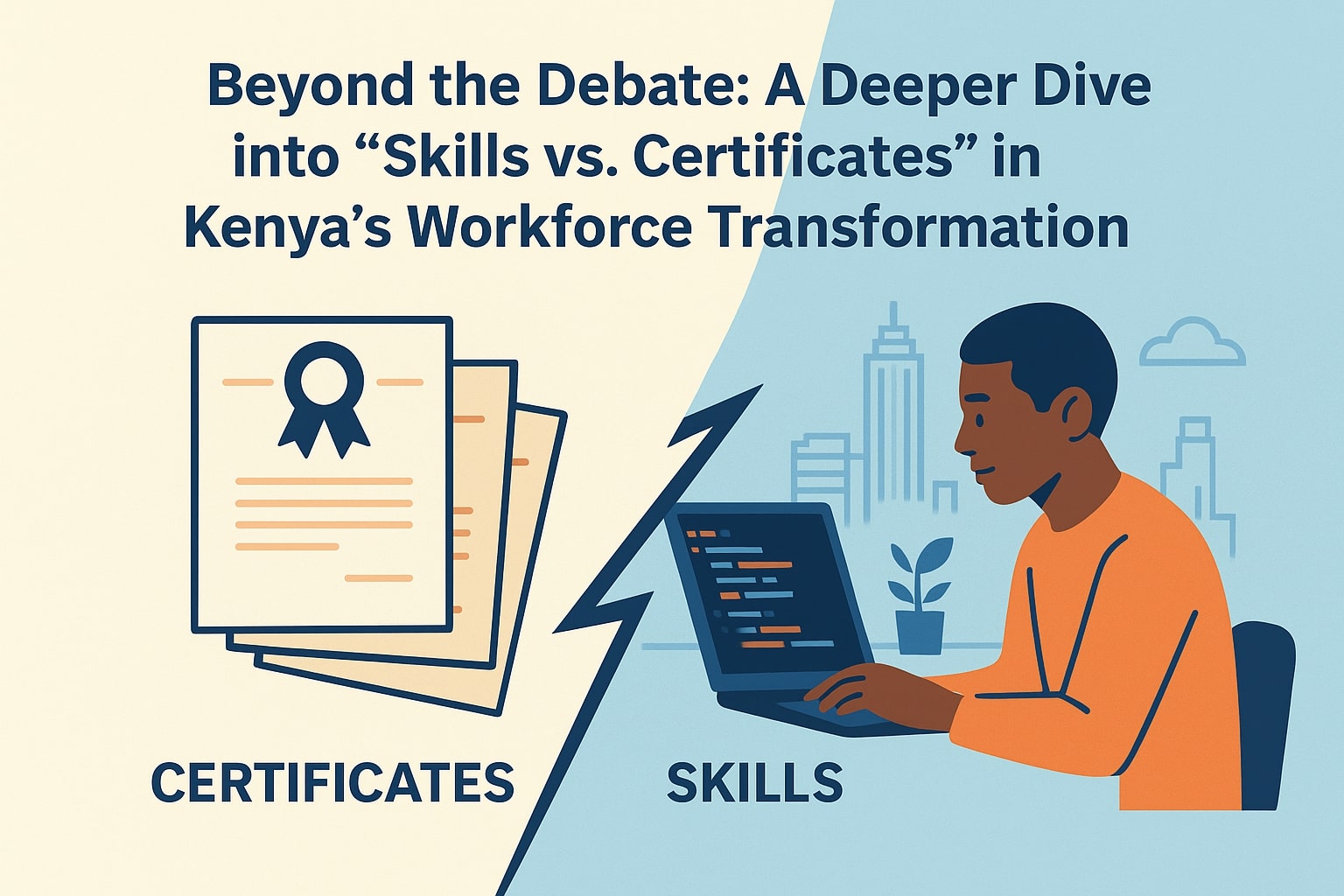
The previous article — “Skills vs. Certificates: What Truly Gets You Hired in Kenya?” — sparked meaningful conversations among Kenyan job seekers, employers and educators alike. The topic touched a nerve because it’s not just theoretical; it’s the living reality shaping thousands of careers daily. Now, let’s unpack that conversation even further — to understand why this debate persists, how it’s changing and what a balanced future could look like in Kenya’s ever-evolving world of work.
1. Why the Skills vs. Certificates Debate Exists
For decades, certificates have symbolized credibility. They were tangible proof of effort and academic success — a passport into employment. But as Kenya’s economy diversified beyond traditional sectors, employers began to notice a troubling mismatch: graduates with certificates but few job-ready skills. Meanwhile, a new generation of self-taught professionals — coders, digital marketers, artisans and creators — began proving that skill, not paper, drives productivity.
This mismatch is not just about education; it’s about how we define competence. Certificates validate learning, but skills validate capability. The challenge lies in bridging that gap — ensuring that education systems translate knowledge into employability.
2. The Underlying Economic Shift in Kenya
Kenya’s economy is shifting toward innovation-driven growth. The rise of digital entrepreneurship, the gig economy and remote work has upended traditional hiring models. Employers today value agility — the ability to learn fast, adapt faster and deliver real results.
- Startups prioritize creativity, digital literacy and execution over formal titles.
- SMEs hire based on demonstrable competence — often through trials, portfolios or short-term contracts.
- Corporates are restructuring HR criteria to include project-based evaluation and Continuous Professional Development (CPD).
In this context, Kenya is experiencing a democratization of opportunity. With a smartphone and an internet connection, anyone can learn, create and showcase expertise — often outperforming traditional graduates who rely solely on academic credentials.
3. The Psychological and Cultural Factor
Kenya, like much of Africa, grew up revering the phrase “education is the key to success.” While still true, what’s changing is how we interpret “education.” Today, education extends beyond classrooms into online platforms, workshops, YouTube tutorials and mentorship programs. However, the psychological weight of certificates remains strong — partly due to parental expectations and societal validation.
Employers, on the other hand, are becoming more pragmatic. They’ve learned that degrees don’t always translate to job readiness. As one Nairobi-based recruiter aptly put it: “We hire for attitude and ability; we train for specifics.”
4. The Rise of Hybrid Professionals
The true winners in Kenya’s modern job market are the hybrid professionals — individuals who combine the structured foundation of formal education with the adaptability of hands-on skill mastery.
- A journalism graduate who masters video editing and social media storytelling.
- An accountant who learns Excel automation, data analytics or QuickBooks integration.
- A teacher who leverages e-learning platforms to create interactive online courses.
These professionals don’t view the “skills vs. certificates” debate as an either-or choice. They view it as a partnership. Their degrees open doors, and their skills keep those doors open.
5. What Employers Can Do
Employers have the power to shape the narrative by designing recruitment systems that value both education and demonstrable skill. Some strategies include:
- Adopt skills-based hiring: Use performance tasks, portfolio reviews and simulations during recruitment.
- Offer internship-to-hire pipelines: Let graduates prove themselves practically rather than through paperwork alone.
- Invest in upskilling programs: Encourage employees to take short courses or certifications relevant to emerging trends.
- Collaborate with TVETs and digital academies: Co-develop practical modules aligned with market realities.
6. What Job Seekers Can Do
For Kenyan job seekers, the winning formula is clear: combine your formal credentials with continuous skill development.
- Start where you are: Leverage free or affordable online platforms like Coursera, Google Skillshop or ALX Africa.
- Build a portfolio: Showcase your work — whether it’s designs, articles, code or community projects.
- Network strategically: Join LinkedIn groups, attend local career events and engage in mentorship programs.
- Embrace lifelong learning: The job you’re training for today may evolve tomorrow — stay ready to pivot.
7. The Policy Perspective: Kenya’s Emerging Education Reform
Kenya’s education sector is gradually adapting through the Competency-Based Curriculum (CBC) and the expansion of TVET institutions. These reforms prioritize demonstrable competencies over rote memorization. The goal is to align learning outcomes with employability — where a graduate’s output, not just their certificate, becomes the metric of success.
If implemented effectively, this shift could bridge the long-standing gap between theory and practice, producing graduates who are both knowledgeable and productive.
8. The Road Ahead – Integration, Not Opposition
The future of employment in Kenya belongs to those who master both theory and practice. Certificates validate your academic journey; skills validate your professional impact. The two are not rivals — they are allies.
The ideal Kenyan professional of tomorrow will be:
- Educated enough to understand frameworks and principles.
- Skilled enough to apply those frameworks in real-world contexts.
- Adaptable enough to evolve with technology and market shifts.
Ultimately, the question is no longer “Skills vs. Certificates.” It’s “How can we make both work together for Kenya’s sustainable economic growth?”
The Mtaa Jobs vision is to empower every Kenyan — regardless of background — to access meaningful work through a fair blend of opportunity, merit and growth. Whether you’re a degree-holder seeking practical exposure, or a self-taught talent looking for recognition, the door to success is wide open. Walk through it equipped with both — your certificate in one hand and your skills in the other.