
Skills Vs Certificates
Skills vs. Certificates – What Truly Gets You Hired in Kenya?
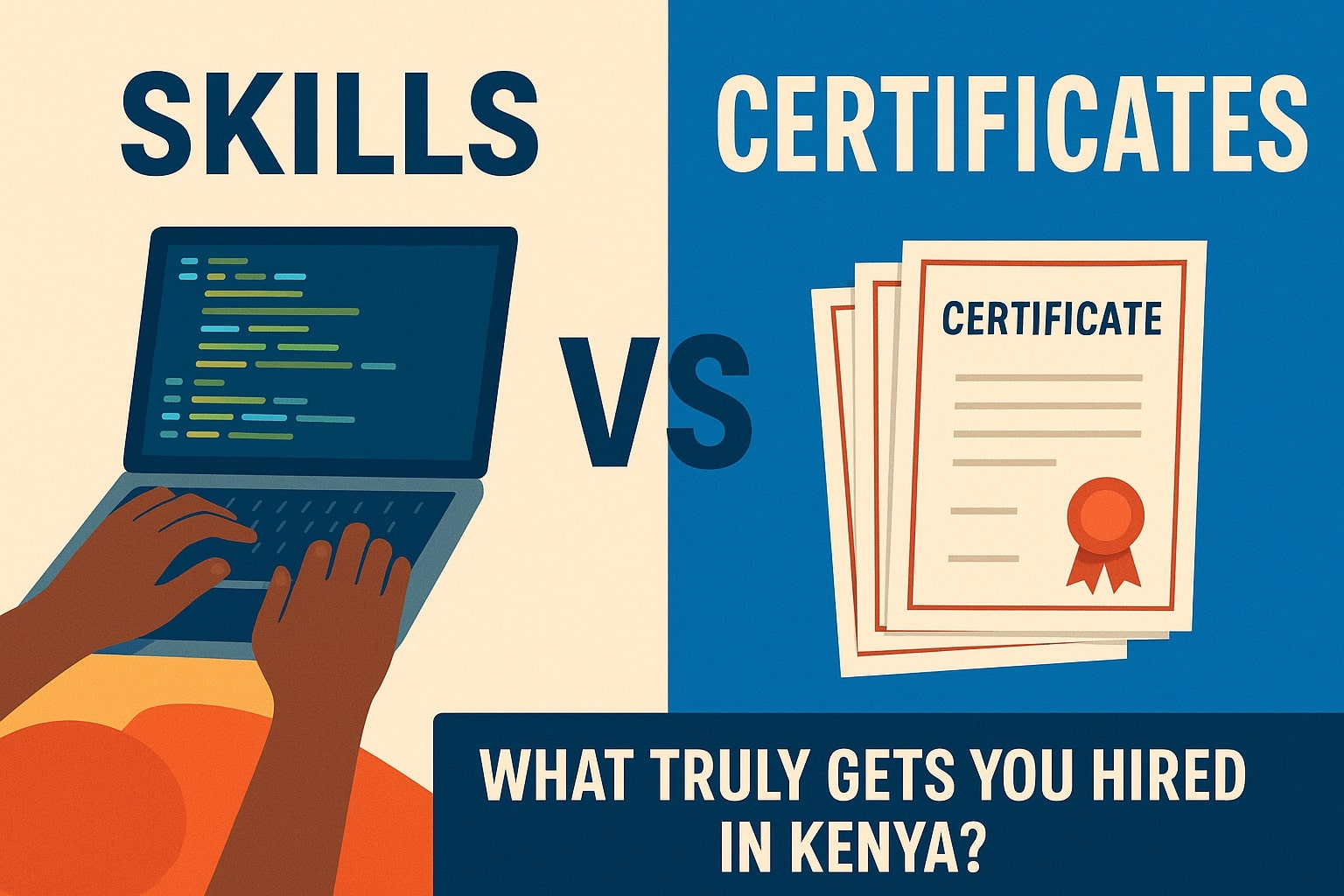
For generations, the path to a promising career in Kenya was clear: excel in school, get your certificates, graduate from university and land a good job. This was the gospel truth, preached by parents and teachers alike. However, the 21st-century job market, particularly in rapidly evolving economies like Kenya, is rewriting the rules. Today, a fierce debate rages in HR departments, educational institutions and among job seekers: what truly matters more—a stack of impressive certificates or a demonstrable set of practical skills? This isn't just an academic discussion; it’s a career-defining question for every Kenyan youth. Let's pit "Skills" against "Certificates" in the ultimate showdown to see what employers are really looking for.
Round 1: The Certificates – The Traditional Gatekeepers
Certificates represent formal education: degrees, diplomas, professional accreditations. They are the badges of traditional learning, proving you’ve put in the time and mastered theoretical knowledge.
The Power of the Paper (Advantages):
- Entry Ticket to the Interview Room: In Kenya, a degree or diploma is often the first filter. Many job applications explicitly state "minimum qualification: Bachelor's degree" or "relevant professional certificate." Without it, your CV might not even get a second glance.
- Demonstrates Discipline & Commitment: Completing a certificate shows perseverance, the ability to learn and commitment to a long-term goal. It indicates you can follow instructions and see tasks through.
- Foundation of Theoretical Knowledge: Certificates provide a structured understanding of fundamental concepts, theories and best practices in a given field. This theoretical base is crucial, especially in fields like engineering, medicine, law or finance.
- Networking Opportunities: Universities and colleges are fertile grounds for building professional networks with peers and lecturers, which can be invaluable later in your career.
- Regulatory Compliance: In many regulated professions (e.g., medicine, accounting or law), specific certifications are not just preferred, but legally mandated for practice.
- Status & Perceived Credibility: Unfortunately, there's still a societal bias towards formal qualifications. A certificate often carries a certain level of respect and credibility in the initial stages.
The Limitations of the Label (Disadvantages):
- Outdated Curriculum: Academic programs can sometimes lag behind rapid industry changes, especially in tech. What you learned three years ago might already be partially obsolete.
- Lack of Practical Application: Many graduates emerge with theoretical knowledge but little to no practical experience, making them less "job-ready."
- High Cost & Time Commitment: Obtaining degrees and professional certificates is a significant investment of time and money, a burden for many Kenyan families.
- Doesn't Guarantee Competence: A certificate proves you passed exams, not necessarily that you can do the job effectively or adapt to real-world challenges.
- Market Saturation: In some fields, the market is flooded with graduates holding similar certificates, making differentiation difficult without additional skills.
Round 2: The Skills – The Modern Mavericks
Skills are the practical abilities and competencies you possess—what you can actually do. These are often acquired through experience, self-learning, apprenticeships or short, intensive courses. They are the true currency of the digital age.
The Power of "Can Do" (Advantages):
- Immediate Value to Employers: Companies hire people to solve problems. If you have the specific skills to tackle their challenges (e.g., "Can you build this website?", "Can you run this digital campaign?"), you become instantly valuable.
- Agility & Adaptability: Skills can be acquired quickly through online courses (Coursera, Udemy), bootcamps or practical projects. This allows you to adapt swiftly to new industry demands.
- Demonstrable Proof (Portfolios!): Unlike a certificate, skills can be showcased. A graphic designer has a portfolio, a programmer has a GitHub profile, a writer has published articles. "Show, don't just tell" is the mantra here.
- Cost-Effective Learning: Many high-demand skills can be learned affordably, or even for free, through online resources, mentorship, and open-source projects.
- High Earning Potential: Niche, high-demand skills (e.g., data science, cybersecurity or UX design) often command premium salaries, regardless of traditional degrees.
- Fosters Entrepreneurship: Strong practical skills empower individuals to start their own businesses, creating solutions and employment without waiting for formal job offers.
The Blind Spots (Disadvantages):
- Initial Barrier to Entry: Without a certificate, you might struggle to get past automated HR systems or initial screening processes, even if your skills are top-notch.
- Lack of Holistic Understanding: Focusing solely on skills might lead to a narrow understanding of a field, missing broader theoretical contexts or ethical considerations.
- Quality Varies Widely: Unlike standardized certifications, the quality of self-taught or informally acquired skills can be inconsistent and harder for employers to vet without extensive testing.
- "Soft Skills" Can Be Underrated: While technical skills are key, soft skills (communication, teamwork, critical thinking) are crucial and can be harder to demonstrate without a formal learning environment or work history.
- Not Recognized Everywhere: While gaining traction, some conservative industries or employers still heavily prioritize traditional qualifications.
Round 3: The Kenyan Reality – A Hybrid Approach Wins the Day
In the dynamic Kenyan job market, the ultimate winner isn't exclusively "Skills" or "Certificates." It's a powerful combination of both.
- Certificates Open Doors, Skills Seal the Deal: A certificate gets your foot in the door, but it's your demonstrable skills and experience that land you the job and allow you to excel.
- The "Kazi Mtaani" & TVET Revolution: Government initiatives and the growth of Technical and Vocational Education and Training (TVET) institutions are shifting focus towards practical, job-relevant skills, making them increasingly recognized.
- Proof of Work: Employers are increasingly asking for portfolios, practical assignments and case studies during interviews. Your ability to do will always speak louder than a paper that says you learned.
- The M-Pesa Example: The digital economy thrives on skills. M-Pesa agents don't necessarily need advanced degrees; they need practical financial literacy and customer service skills. Tech developers for M-Pesa services need coding skills, often honed outside traditional universities.
- Continual Learning is Key: The most successful individuals are those who combine their foundational certificates with a relentless pursuit of new, relevant skills through short courses, online platforms and hands-on projects.
Think of it this way: Your certificate is your driving license, proving you understand the rules of the road. Your skills are your ability to navigate the complex traffic of Nairobi, troubleshoot a breakdown and get your passengers safely to their destination. Both are essential for a successful journey.
In the grand arena of career development, the showdown between skills and certificates isn't about one completely defeating the other. It's about synergy. For Kenyan youth, the wisest strategy is to pursue relevant certificates to open initial doors, but then relentlessly build and showcase practical, in-demand skills. Invest in both your formal education and your practical competencies. That potent combination is your winning formula for not just getting hired, but truly thriving in Kenya's exciting and ever-changing job market.