
The 2026 Financial Pivot
The 2026 Financial Pivot: Moving from Survival to Strategy
How to stop reacting to the economy and start building your own wealth ecosystem.
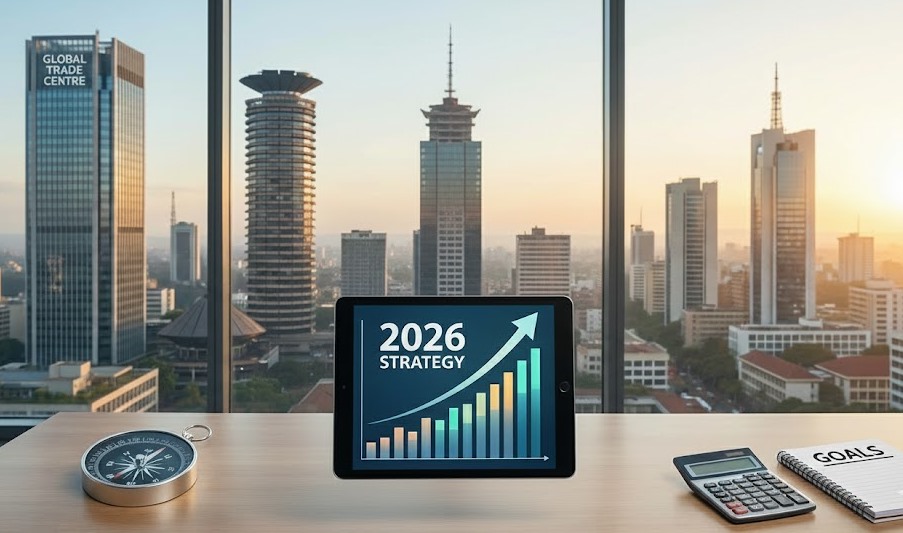
Let’s be honest about the current landscape. The last few years in the Kenyan economy have felt like an endurance sport. Between fluctuating fuel prices, new tax regimes and the general cost of living, many professionals and business owners have shifted into "survival mode."
Survival mode is necessary for the short term, but it is disastrous for the long term. When you are only focused on making it to the end of the month, you cannot build wealth.
As we approach 2026, it is time for a pivot. You need to shift from playing defense to playing offense. You need a strategy that doesn't just account for inflation, but beats it. This article is your blueprint for that shift. It is designed to help you set concrete, ambitious, yet achievable financial and business goals for the coming year.
Phase 1: The Brutal Reality Check (December 2025)
You cannot plan a route to a destination if you don't know where you are currently standing. Before you set a single goal for 2026, you must perform a financial audit. This will be uncomfortable, but it is non-negotiable.
1. Calculate Your True Net Worth
Do not confuse your salary with your wealth. Your net worth is the only number that matters. It is simply: Total Assets minus Total Liabilities.
- Assets: Cash, savings, investments (MMFs, Sacco shares, stocks), real estate equity, business equity. (Do not include your car unless you plan to sell it downsize).
- Liabilities: Bank loans, mobile app loans, Sacco loans, mortgage balances, credit card debt.
If the number is negative, don't panic. That is your baseline. Your primary goal for 2026 is to turn that number positive or grow it significantly.
2. The "Leakage" Audit
Print out your last three months of M-Pesa and bank statements. Highlight every expense that was not essential (rent, food, transport, utilities). Where is your money "leaking"? Is it excessive entertainment, black tax that has no boundaries, or impulse purchases? You must plug the leaks before you pour more water into the bucket.
Phase 2: Building the Defense (Q1 2026 Goals)
Before you try to get rich, ensure you won't get poor. A strong defense is the foundation of wealth building.
Goal 1: Fully Fund Your Emergency Brake
In this economy, one medical emergency or sudden job loss can erase five years of progress. Your goal is to have 3 to 6 months of living expenses liquid.
The Strategy: Do not leave this money in a standard current account where inflation eats it. Place it in a Money Market Fund (MMF). In Kenya, decent MMFs yield between 10% and 15% annually. Your emergency fund should at least keep pace with inflation while remaining accessible.
Goal 2: Eliminate Toxic Debt
Not all debt is bad. A mortgage or a business loan to buy an asset can be "good debt." But high-interest consumer debt—especially mobile loans and credit cards—is toxic. It is financial cancer.
The Strategy: Use the "Debt Avalanche" method. List your debts from highest interest rate to lowest. Pay minimums on everything else and throw every extra shilling at the debt with the highest interest rate until it's gone. Repeat.
Phase 3: The Growth Engine (Q2-Q4 2026 Goals)
You cannot budget your way to massive wealth. Eventually, you hit a floor on cutting expenses. To truly pivot in 2026, you must focus on increasing your income.
The Career Path: The Value-Add Raise
Stop waiting for an annual review to hope for a 5% inflation adjustment. Set a goal to secure a 20%+ income increase in 2026.
The Strategy: You don't get paid for time served; you get paid for value created. Identify a major pain point for your employer and solve it. Quantify your results (e.g., "I saved the company Ksh 500,000 in operational costs"). Present this data and negotiate. If they won't pay, the market will. Update your CV and start looking.
The Business Path: From Side Hustle to Second Stream
If you don't have a business, 2026 is the year to start one. If you have a "side hustle" that makes sporadic pocket money, 2026 is the year to professionalize it into a reliable income stream.
The Strategy: Stop trying to invent the next Facebook. Look for unglamorous problems people pay to have solved. Can you offer specialized consulting in your field? Can you provide B2B services? The goal is to generate an additional Ksh 30,000 - Ksh 50,000 monthly that is completely separate from your salary. This money is not for spending; it is purely for investing.
Phase 4: The Wealth Accelerator (Ongoing 2026 Goals)
Once your defense is set and your income is growing, you must put that money to work. Your money should work harder than you do.
Leverage the Power of Saccos
If you are not in a strong Sacco, join one immediately. Saccos are unique to our financial landscape and offer two massive benefits: high dividend payouts on your shares and access to credit at 3-4x your savings at reasonable rates.
The 2026 Goal: Maximize your monthly Sacco contributions to build a substantial borrowing base for future asset acquisition (like land or business capital).
Diversify Beyond Savings
Savings accounts are for safety. Investments are for growth. In 2026, set a goal to allocate a percentage of your income (aim for 15-20%) into income-generating assets.
- Government Bonds/Bills: For lower risk, steady returns.
- NSE (Nairobi Securities Exchange): For those willing to research undervalued companies paying good dividends.
- Offshore Investments: Consider platforms that allow you to invest small amounts in global markets (ETFs) to hedge against local currency fluctuations.
- Mtaa Jobs Team