

How To Write A CV When You Have No Experience
How to write a CV when you have no experience — Kenya edition
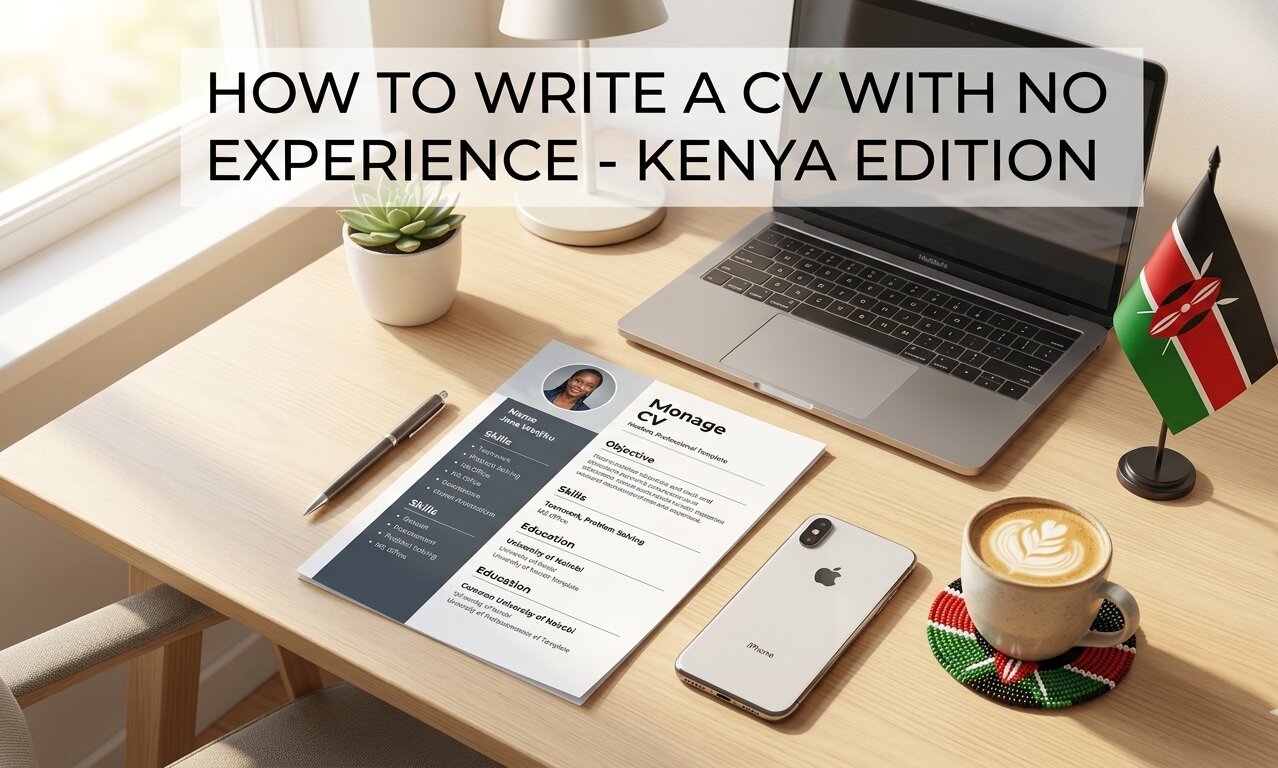
Let's be honest — there's nothing more frustrating than a job advert that says "no experience necessary" and then asks for three years of it. If you're a fresh graduate, school leaver, or someone switching careers, you've probably felt this before. Here's the truth: most employers in Kenya are not looking for someone who's done the exact job before. They're looking for someone who is reliable, willing to learn, and can communicate clearly. Your CV just needs to show that.
"A CV is not a list of everything you've done. It's a short argument for why you're worth meeting."
1. Start with a strong personal statement
The top of your CV should have 3–4 sentences about who you are and what you bring. Don't start with "I am a hardworking person" — everyone says that. Instead, be specific.
Example: "Recent business graduate from Kenyatta University with hands-on experience coordinating events for my college's student council. I'm looking for an entry-level administrative role where I can apply my organisational skills and grow with a team."
Example: "Highly organized individual with a Certificate in Information Technology. Experienced in managing high-traffic digital service environments, including KRA filing and document design. Seeking to leverage my technical proficiency and customer service skills in a fast-paced administrative role."
See how that's specific? It mentions the institution, a real thing they did, and what they want. That's three signals in four lines.
2. Use what you have — it counts more than you think
No formal jobs yet? That's fine. Here's what you can use instead:
- Volunteer work — church groups, community clean-ups, school mentoring. List the organisation, your role, and what you did.
- Side hustles — sold mitumba? Ran errands? Did M-Pesa for a shop? You have customer service and cash-handling experience. Write it down. This proves Financial Accountability and Sales Skills.
- School projects & coursework — group projects, presentations, research papers. These show you can work with others and meet deadlines.
- Sports, clubs & leadership — were you a class rep, sports captain, or club chairman? That's leadership. Name it.
- Family business — helped run the family shop, farm, or salon? That's real, transferable work experience.
3. Highlight your Digital Literacys
In 2026, even "basic" jobs require tech skills. Don't just say "Computer Literate." Be specific about tools common in the Kenyan market:
- Microsoft Office: Mention Excel for bookkeeping or Word for report writing.
- Government Portals: Knowing how to navigate eCitizen, KRA iTax, or NTSA portals is a massive bonus for Kenyan SMEs.
- Design Tools: If you can use Canva or Adobe Illustrator to make posters, list it! Digital content creation is a highly valued "extra" skill.
4. Keep it to one page — always
Many Kenyan job seekers try to fill two or three pages to look more experienced. It has the opposite effect. Employers are busy, they often receive hundreds of applications daily. A cluttered CV is an ignored CV. If they can't see your value in 30 seconds of scanning, they move on.
Rule of thumb: Under 5 years of experience = one page, maximum. Use clean fonts (Arial or Calibri), size 11 or 12, and leave enough white space so it breathes.
Pro Tip: Save your CV as a PDF named "YourName_CV.pdf". Never send it as an editable Word document or a generic file name like "Document1".
5. Tailor it for each job — yes, every time
The biggest mistake people make is sending the same CV for every application. Take 10 minutes to read the job advert properly. What words do they use? What skills do they mention? Mirror that language in your CV — without lying.
If the job says "attention to detail," find a real example from your life where you showed attention to detail and put it in your CV. That simple shift gets your application noticed.
6. Don't forget the basics
- Use a professional email address — firstlastname@gmail.com, not "coolkid2003."
- Include your phone number and town/area — employers want local candidates.
- List 2 referees with working phone numbers — a teacher, pastor, or former supervisor works fine.
- Proofread. Then proofread again. Spelling mistakes are the fastest way to the bin.
6. One last thing
Your CV gets you the interview. Your attitude gets you the job. So once you've sent that application, prepare — know something about the employer, think through the questions they might ask and show up on time.
You've got more to offer than you think. Put it on paper and let the right employer find you.
Ready to put that new CV to work?
Browse local jobs across Kenya — no agents, no fees.
Browse jobs on Mtaa Jobs →